

Precision Pool Leak Detection Services in Southeast Florida
Ensure Safety, Compliance, and Longevity for Your Backyard Oasis

5-STAR
RATING

24 + YEARS
EXPERIENCE

CERTIFIED MASTER INSPECTOR

PEACE OF MIND
Is your swimming pool losing more than a quarter-inch of water per day? In Florida's sunny climate, routine evaporation occurs, but continuous water loss can wash out sub-base soils, undermine concrete deck foundations, and burn out expensive circulation pump motors. Kenco Home Inspections provides non-invasive, precision pool leak detection across Jupiter, Palm Beach Gardens, West Palm Beach, Stuart, Port St. Lucie, and South Florida communities to isolate the exact source of water intrusion or loss.
Warning Signs Your Pool Has a Structural or Plumbing Leak
Excessive Water Loss: Water level dropping more than 1/4 inch in a 24-hour period (exceeding standard environmental evaporation).
Frequent Auto-Fill Activation: Automatic water leveling valves running continuously, resulting in sudden spikes in municipal water bills.
Sunken Pavers & Deck Voids: Depressions or shifting deck pavers adjacent to the pool edge caused by subsurface soil erosion.
Air Bubbles in Return Jets: Constant streams of micro-bubbles discharging into the pool, indicating a suction-side plumbing line breach.
Algae Bloom Inability to Balance Chemicals: Constant loss of treated water forces frequent fresh tap water replenishment, throwing off cyanuric acid, salt, and chlorine stabilization.
Our Comprehensive Diagnostic Testing Protocol
We deploy specialized diagnostic procedures to pinpoint leaks without unnecessary excavation or structural demolition:
1. Evaporation vs. Leak Analysis: The 24-Hour Bucket Test
To establish an empirical baseline between natural solar evaporation and an active physical leak, we guide homeowners through or conduct calibrated bucket differential testing. Because ambient humidity, wind velocity, and direct sunlight evaporate water at the identical rate inside a step-mounted bucket as from the open pool surface, any variance where the outside pool level drops faster than the bucket confirms an active leak.
2. Precision Dye Testing (Dye Injection Analysis)
Using concentrated, water-soluble, non-toxic diagnostic dyes, our specialists test static structural fittings under calm water conditions:
Skimmer Throats & Cold Joints: Testing the vulnerable seam where the plastic skimmer box joins the concrete pool shell.
Underwater Light Niches: Inspecting the light fixture conduit opening—one of the most common leak locations in Florida swimming pools.
Return Jet & Drain Fittings: Injecting indicator dye at threaded fittings, hydrostatic valves, and tile waterline fissures to observe active suction pull.
3. Hydrostatic Pressure Testing of Subterranean Plumbing Lines
Plumbing buried under concrete decks and landscaped yards requires mechanical isolation:
We install pneumatic inflatable test plugs to seal each individual line: skimmer lines, main drains, return lines, dedicated suction cleaner lines, and water feature feeds.
Lines are pressurized with air or water and monitored with sensitive digital test gauges. A drop in pressure confirms a subterranean pipe fracture, joint separation, or tree root puncture.
4. Electronic Acoustic Listening & Sonar Diagnostics
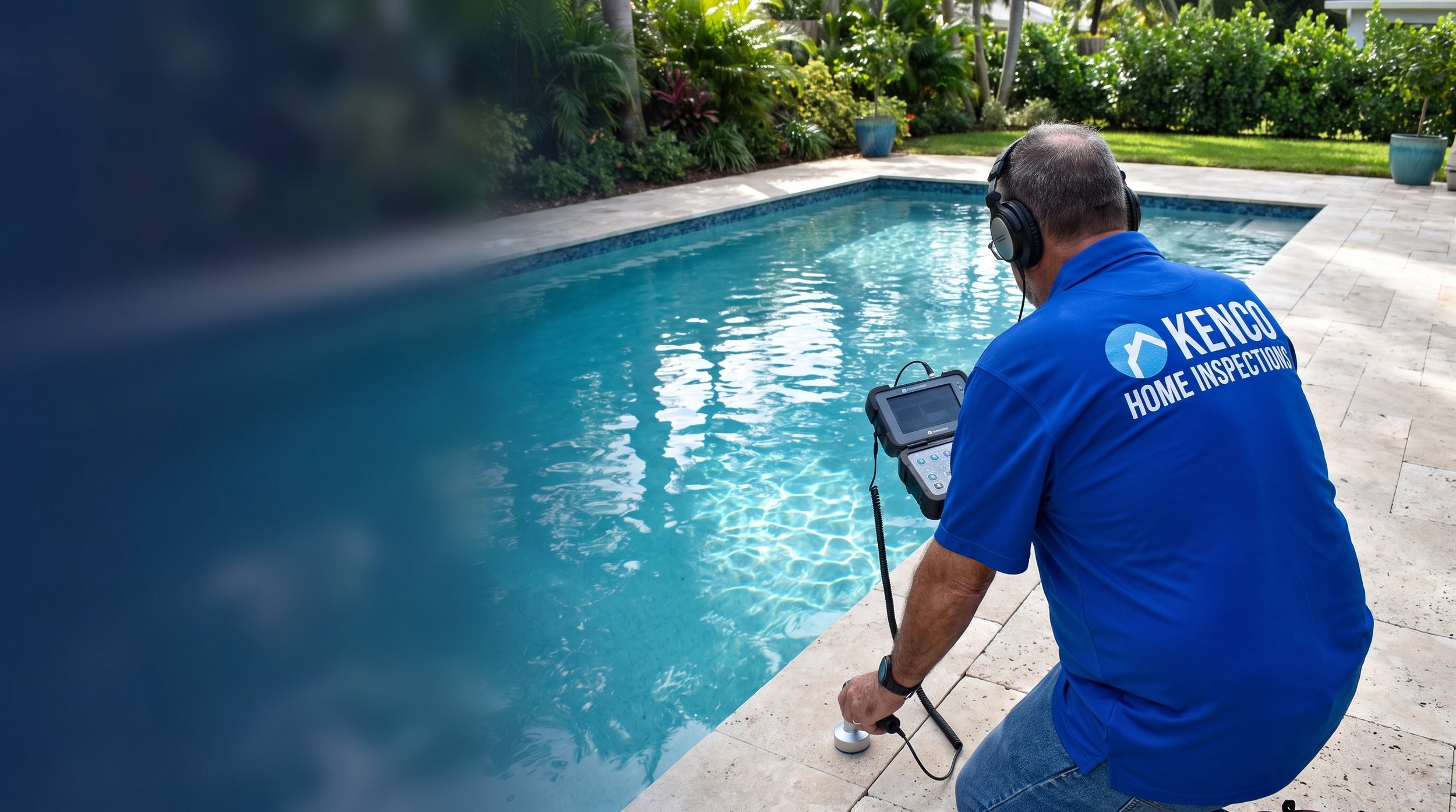
When underground pipes fail beneath solid concrete or travertine decks, acoustic listening hydrophones detect the high-frequency vibration and sound produced by pressurized water escaping into surrounding soil, pinpointing the repair zone to minimize deck cutting.
Pool Leak Detection Frequently Asked Questions (FAQ)
How do I know if my pool is leaking or just evaporating?
Standard evaporation in South Florida rarely exceeds 1/8 to 1/4 inch of water per day, depending on wind, humidity, and sun exposure. If your pool loses 1/2 inch or more in 24 hours, or if you find yourself refilling the pool multiple times a week, you have an active leak. Performing a 24-hour bucket test confirms whether water loss is environmental or structural.
What is a dye test and how does it find leaks?
A dye test uses a dense, non-toxic colored fluid placed millimeters away from suspected crack locations, tile seams, light niches, and skimmer faces. Because water moves toward the low-pressure void of a leak, the dye is visibly pulled into the crack or opening, providing definitive visual confirmation of the defect.
Should buyers order a pool leak inspection when purchasing a Florida home?
Yes, absolutely. A visual home inspection does not pressure-test underground plumbing or execute dye diagnostics. If an aging pool has broken suction pipes under the deck or an underground leak that erodes the foundation, repairs can easily exceed $3,000 to $10,000. Identifying these defects during your contract inspection period provides crucial negotiation
Book Your Pool & Spa Inspection Today
Ready to move forward? Schedule your inspection instantly or contact our team for specialized pricing.
Online Scheduling: Click here to book via Spectora
Direct Support: Call or Text 561-718-6711
Service Areas: Palm Beach, Martin, St. Lucie, Broward, Indian River.
Pool & Spa Inspection Frequently Asked Questions
Does a standard Florida home inspection include the pool and spa?
No. Standard residential home inspections evaluate the core dwelling (roof, structure, electrical, plumbing, HVAC, interior). Pool and spa inspections require specialized technical knowledge of hydraulics, chemical feeders, bonding, and safety barriers, and are scheduled as a dedicated ancillary service.
How long does a pool and spa inspection take?
A detailed pool and spa inspection typically takes between 45 and 75 minutes on-site, depending on the complexity of the equipment pad, water features, spa automation, and heater configurations.
Do you test the pool water chemistry?
Our inspection focuses on physical condition, functional performance, mechanical operation, and safety standards. While we assess water clarity and visible algae growth, daily chemical balancing (free chlorine, pH, stabilizer, total alkalinity) is part of routine pool maintenance and outside the scope of a property condition inspection.
Can a visual pool inspection tell me if there is an underground leak?
A visual inspection identifies observable signs of water loss—such as soil erosion, sunken pavers, cracked skimmers, or dropping waterlines. However, pinpointing subterranean plumbing fractures requires dedicated hydrostatic pressure testing and acoustic listening, which is performed under our specialized Pool Leak Detection Service.